What Types of Watch Repairs Can We Do?
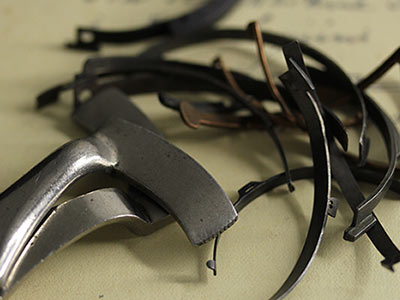
Broken Mainspring
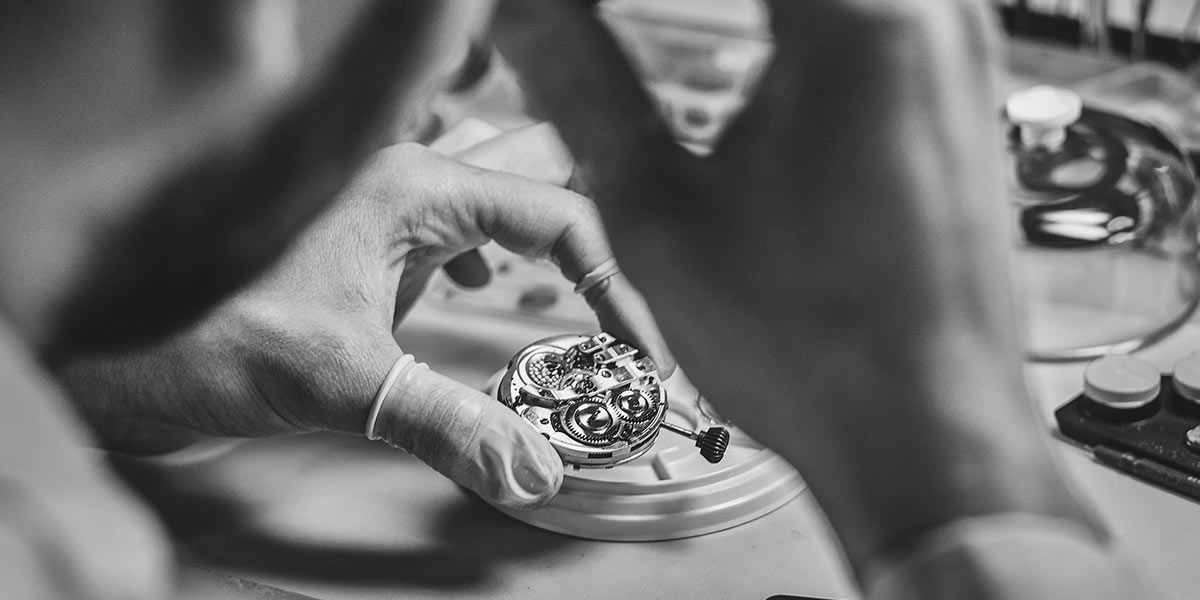
A broken mainspring is a common problem, especially in older watches. However, finding the correct replacement can be difficult, particularly for antique pocket watches with larger or less common mainspring sizes.
At TOKEI Works, we stock a wide range of mainsprings and can also source them from overseas. We carefully measure the original mainspring, assess its specifications and strength, and find a suitable replacement.
Many repair shops decline pocket watch repairs because they cannot obtain the correct mainspring. We can work with a wide range of sizes, from large antique pocket watches to small pocket watches.
Broken / Missing Watch Crystals
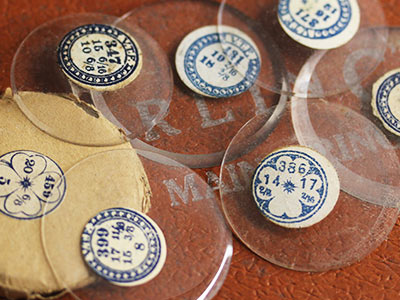
A cracked, scratched or missing crystal doesn’t necessarily mean you need to give up on your watch. At TOKEI Works, we stock a range of replacement crystals, and standard round crystals are generally easy to source and replace.
Antique Pocket Watches
Pocket watches require different types of crystals depending on their case design.
Open-face pocket watches typically use thicker crystals, while hunter-case pocket watches, which have a protective lid that opens to reveal the dial, require much thinner crystals.
Hunter-case crystals can be particularly challenging to source and fit. They must be extremely thin and have the correct height to fit within the limited space inside the case without interfering with the lid.
Vintage Wristwatches from the 1930s to the 1950s
Wristwatches from this period often feature distinctive case designs, with crystals specially shaped to complement each watch’s appearance.
Hundreds or even thousands of different crystal designs were produced, making it difficult to find the exact replacement for a particular watch.
We have access to historical documentation to help identify the correct crystal and search for a suitable replacement. Although finding an exact match can be challenging, we take the time to investigate the available options and do our best to find a solution.
Whether your watch needs a simple round crystal or an unusual shape from a century-old design, we’ll do our best to find the right fit.
Missing Crown or Crown and Stem Pulled Out
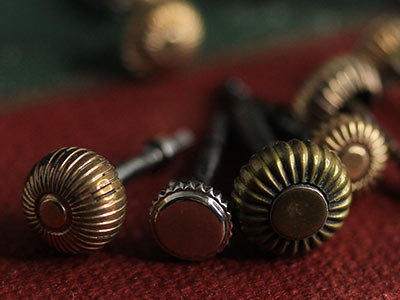
Watch crowns are subject to wear through years of use. On vintage wristwatches, crowns were often relatively simple components without a manufacturer’s logo, making suitable replacements easier to source. However, finding a crown that matches the original in size, shape and appearance can still be challenging.
Pocket watch crowns also wear over time. Replacement crowns are available for many models, although finding one that closely matches the original design and dimensions can be more difficult.
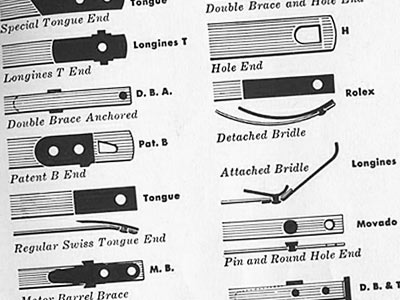
We can also source or make replacement stems to suit the watch. The stem must have the correct dimensions and thread, as well as the appropriate length and configuration for the movement and crown.
If the crown and stem have come out of the watch together, the problem is usually related to the stem-retaining component inside the movement. This small component holds the stem in its correct position.
If it is worn, damaged or displaced, the stem may no longer stay in place. We can inspect this component and, if necessary, repair, adjust or replace it. If a suitable replacement is unavailable, we may also be able to make a replacement part.
Damaged or Discoloured Watch Dials
The materials and construction of watch dials vary depending on the age and type of watch. Some antique pocket watches and early wristwatches feature white, glossy porcelain dials, while many later watches have painted metal dials. Each type requires a different approach to cleaning and restoration.
Porcelain/Enamel Dials
White porcelain/enamel dials have a smooth, glossy finish, much like a porcelain plate. Unfortunately, if the porcelain is cracked, has hairline fractures, or has chipped areas or holes, the original surface cannot be properly repaired.
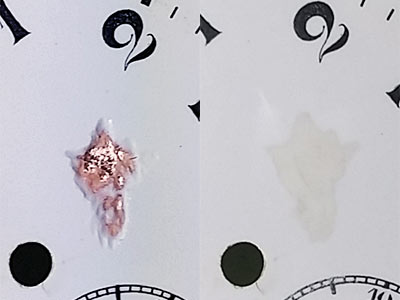
Where possible, we can look for an original replacement dial that closely matches the existing one. If there is a small hole or chip exposing the base underneath, we may be able to fill the damaged area to improve its appearance. However, the repaired area will not perfectly match the original white colour or glossy finish.
Ordinary dirt and surface deposits on porcelain dials can often be carefully cleaned.
Painted Metal Dials
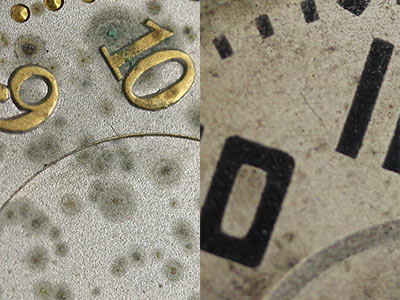
Stains and discolouration on painted metal dials are often caused by deterioration or corrosion of the original dial finish. Unfortunately, once the paint or surface coating has deteriorated, it cannot usually be restored through cleaning alone.
Dust and loose surface impurities can often be removed. Green corrosion, sometimes called verdigris, may also be cleaned away, but it can leave permanent marks or traces on the dial.
Complete Dial Refinishing
If you want the dial to look as close to new as possible, complete refinishing or repainting may be an option.
However, a refinished dial can look noticeably newer than the rest of the watch. This may affect the watch’s original character and make it look out of place, particularly on an antique or vintage timepiece. Dial refinishing can also be time-consuming and costly.
Our approach is to preserve the original dial wherever possible. We’ll assess its condition and discuss the available options with you before carrying out any work.
Missing or Incorrect Watch Hands
Missing, damaged or incorrect hands are common problems with antique pocket watches and vintage wristwatches.
Over the years, original hands may have been damaged and replaced with whatever was available at the time. Finding an exact match was often difficult, so watches were sometimes fitted with hands that did not suit their original design. Others were left without hands altogether and put away rather than repaired.
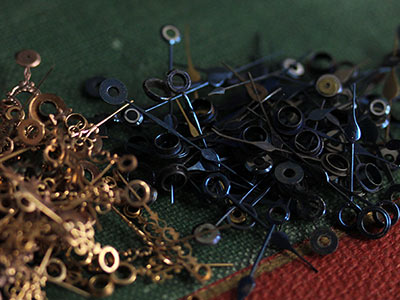
Watch hands come in a remarkable variety of styles and designs. These include spade-shaped hands, delicate leaf-shaped hands, luminous hands with distinctive designs, and beautifully crafted hands found on antique pocket watches. Each style contributes to the character and appearance of a watch.
Replacing watch hands is more complicated than it might seem. They need to match not only the original design but also the precise specifications of the movement. Even a tiny difference in dimensions can prevent them from fitting or working correctly.
Important measurements include:
Fitting-hole diameter: The hole must match the diameter of the hand’s mounting point on the movement.
Tube height: The height and shape of the hand’s mounting tube must provide the correct clearance.
Hand length and width: The hands must be the correct length and proportions for the dial.
Design and appearance: The style should be appropriate for the watch and, where possible, match its original hands.
At TOKEI Works, we can investigate suitable replacement hands and, where possible, source original or compatible parts. Identifying the watch’s manufacturer and movement can make this process easier, as some brands provide parts numbers and technical specifications that help us find the correct hands.
Whether your watch has lost its hands, has damaged hands, or has been fitted with unsuitable replacements, we’ll investigate the possibilities of finding a suitable set.
Damaged or Worn Watch Cases
Whether a damaged watch case can be restored depends on its material and condition. In some cases, polishing and careful cleaning can improve the appearance by removing surface marks, dirt and minor scratches.
However, not all watch cases can be polished safely. Some vintage cases are made of gold-filled material or have a thin gold or silver plating over a base metal. Polishing these cases can wear away the outer layer and expose the metal underneath. For this reason, we need to identify the case material and assess its condition before recommending any polishing.
Worn or Damaged Plating
If the plating has worn away or the base metal is visible, replating may be an option. Depending on the case material and its condition, we may be able to restore the surface with a new layer of plating, giving the case a much fresher appearance.
However, the results depend on the condition of the case and the suitability of the material for replating. We’ll need to examine it before confirming what is possible.
Plating Can Wear Away Gradually
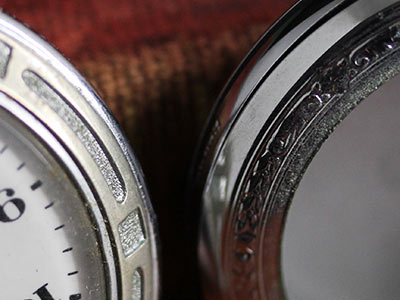
A watch case may still look attractive from a distance, even when its plating is beginning to deteriorate. Small areas of wear, discolouration and changes in the surface finish can become much more noticeable under magnification.
In the example shown, the chrome plating on the left side has clearly worn away. The right side appears to have a good silver-coloured finish at first glance, but closer inspection reveals signs of patina and early plating wear.
Before polishing or refinishing a watch case, it’s important to understand what the case is made of and how much of its original finish remains. We’ll assess the condition and advise you on the most suitable options.
Missing or Replaced Watch Cases
Missing or replaced cases are not uncommon with antique pocket watches, particularly in Japan.
During wartime, valuable metals such as gold and silver were requisitioned by the government. As a result, many watch cases were removed and replaced with cheaper alternatives, often made of chrome-plated or other base metals.
If you or your family know that this happened to your watch, it may be possible to find a replacement case made from the original material, restoring the watch closer to its original appearance. This is more feasible when the manufacturer and model can be identified.
The same applies if you have a watch movement and dial but no case, or if the existing case does not look or feel right for the watch. We may be able to help find a suitable replacement case.
However, finding a case that fits correctly is not easy. The dimensions, design and movement specifications all need to match. For this reason, we can only investigate this option when the manufacturer and model can be identified with reasonable confidence.
Have a watch with a missing or incorrect case? If we can identify its maker and model, we’ll do our best to explore the possibilities of finding a suitable replacement.
Pocket Watch Lid Won’t Open or Close Properly
Some pocket watches have a protective cover over the dial, known as a hunter case. The lid should open smoothly and close securely, but problems can develop over time, especially with older watches.
There are several possible causes, including damaged hinges, broken or missing case springs, and wear to the lid or its surrounding edges.
Broken or Damaged Hinges
Hunter-case hinges can become damaged or worn through years of use. Depending on the case material and condition, we can often repair broken hinges. Gold and silver cases may be suitable for this type of repair, although each case needs to be assessed individually.
Worn or Damaged Lid
The lid itself can also become worn, bent or damaged, preventing it from closing properly. This can be particularly difficult to repair, even when the case is made of gold or silver. The possibility of repair depends heavily on the extent and location of the damage.
Broken or Missing Case Springs
The case spring helps the lid open and close with the correct action and tension. If it is broken or missing, the lid may not function properly.
We keep a range of case springs and can look for a suitable replacement. However, pocket watches use different spring designs and sizes, so not every spring can be fitted to every case.
If your hunter-case pocket watch has a lid that won’t open or close properly, we can examine the mechanism and case to see what can be repaired or replaced.
Discolouration of the Watch Movement
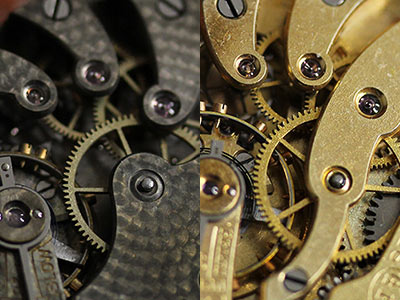
Discolouration on a watch movement can occur naturally over time as the metal ages. It may also be caused by rust, corrosion or changes to the original surface finish.
At TOKEI Works, we clean watch movements as part of the repair and overhaul process. However, we do not polish movement surfaces simply to make them shine.
Polishing involves removing a thin layer of metal, and excessive or unnecessary polishing can alter the original surface finish, remove fine details and potentially damage the movement. This is especially important with antique watches, where preserving the original material and condition matters.
Our focus is on cleaning the movement properly, removing dirt and corrosion where necessary, while avoiding unnecessary removal of the original metal surface. We believe maintaining the movement in the best possible condition is more important than making it look shiny.
Every movement is different. The materials, surface finishes and degree of ageing vary depending on the manufacturer, model and age of the watch. Some movements were originally designed with a bright finish, while others have a matte, brushed or differently treated surface.
Rust and corrosion need to be addressed because they can continue to damage the metal if left untreated. We clean affected areas where possible, but removing rust does not always restore the original surface. Even after cleaning, stains, pitting or other marks may remain.
Our priority is to clean and maintain the movement properly, not to make an old watch look artificially new. We believe preserving its original character and condition is just as important as restoring its function.
Balance Staff Repair and Replacement
One of the more costly and delicate watch repairs involves the balance staff.
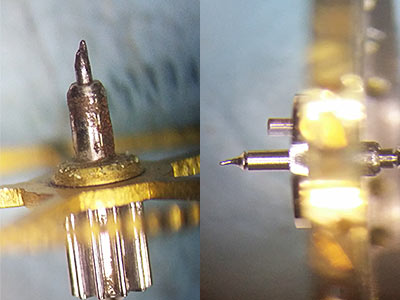
The balance staff is a very small, fine component at the centre of the balance wheel. It has extremely thin pivots at each end and plays an essential role in the movement’s timekeeping. Because of its delicate construction, it can easily break if the watch receives a strong impact, such as being dropped.
Finding or Making a Replacement Balance Staff
If the manufacturer and movement can be identified, we may be able to source a replacement balance staff. Where a suitable original part is unavailable, we may also be able to make a replacement.
Replacing or making a balance staff requires highly precise and delicate work. The dimensions must be extremely accurate, and the component must be fitted correctly for the balance wheel to operate properly.
However, not every balance staff can be replaced. If the movement has been badly repaired in the past, or other parts are severely damaged or in poor condition, replacement may not be possible.
Balance staff work requires considerable skill, time and precision. We’ll carefully examine the movement before determining whether a replacement or repair is feasible.
Gear Repair
Broken or bent gear shafts and damaged gear teeth are common issues in watch repair. Depending on the damage, we may be able to repair the original parts or manufacture replacements.
Bent or Broken Gear Shafts
If a gear shaft is bent, we will carefully attempt to straighten it, applying heat where necessary to reduce the risk of breakage. However, we cannot guarantee that the shaft will not break during the process.
If the shaft is broken or cannot be repaired, we can manufacture a new shaft and fit it to the original gear.
Repairing Broken Gear Teeth
Broken gear teeth can sometimes be repaired, depending on the extent of the damage.
Simply attaching a new tooth to a gear is generally not strong enough to withstand the forces transmitted through the gear during operation. Instead, we cut a recess into the gear and shape the replacement tooth with a specially designed root that fits deeply and securely into the gear body. This creates a strong mechanical connection that helps the replacement tooth withstand the forces applied during operation.
This is a delicate and precise process that requires specialist watchmaking skills. Whether the repair is possible depends on the gear’s condition and the location and extent of the damage.
Repair Request / Contact Us Specialist Watchmaker in Japan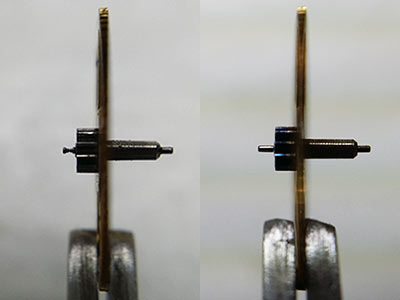
Missing Winding Key or Time-Setting Button
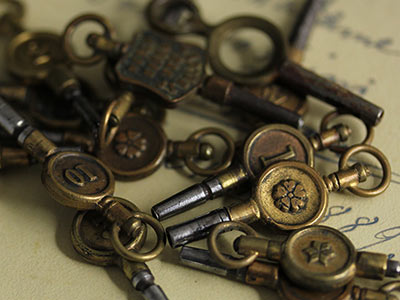
Some antique pocket watches use a separate winding key to wind the movement, while others have a small button on the edge of the case that needs to be pressed to allow the time to be adjusted.
If the winding key or time-setting button is missing, the watch may still be repairable.
Missing Winding Key
We can look for a replacement winding key with the correct size and fitting for your watch. Winding keys come in different sizes, so finding one that fits properly is important.
Missing Time-Setting Button
Some pocket watches have a small button on the side or corner of the case that is pressed to release the time-setting mechanism. If this button is missing, we may be able to make a replacement part to restore its operation.
Whether your pocket watch is missing its winding key or time-setting button, we can investigate the available options and help find or make a suitable replacement.
Chronograph and Minute Repeater Repairs
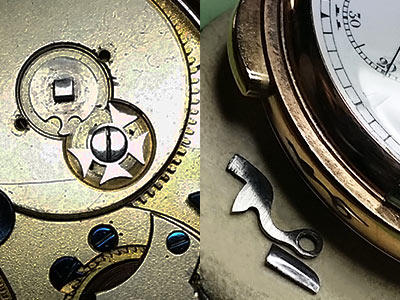
At TOKEI Works, we also undertake repairs to complicated mechanical movements, including chronographs, minute repeaters and quarter repeaters.
These mechanisms are considerably more complex than standard watch movements. They contain many additional components that must work together precisely. Repairing them requires specialist knowledge, careful investigation and a great deal of time.
Specialist Work and Repair Costs
Due to the complexity of these movements, repairs can involve many hours of detailed work. Depending on the watch, its condition and the extent of the damage, the cost can easily exceed 150,000yen or ¥200,000yen.
We assess each watch individually and will discuss the likely work and costs with you before proceeding.
Have a complicated watch that needs attention? Please contact us with details and photographs. We’ll examine the possibilities and advise you on the next steps.
Verge and Fusee Pocket Watches
Verge and fusee pocket watches are much older than the pocket watches commonly seen from around 1900. They use very different mechanical designs and construction methods from later watches.
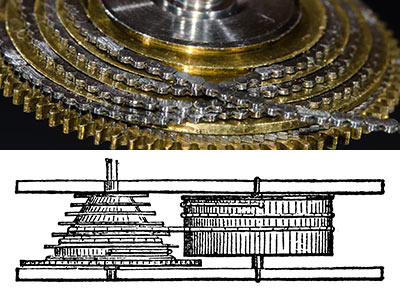
Many fusee watches use a very fine metal chain connecting the mainspring barrel to the fusee cone. This chain plays an important role in the movement and requires careful handling.
Because these watches were often used for many years, it is not unusual to find them in heavily worn condition. Gears may be worn, and the delicate fusee chains may have been cut, shortened or previously reconnected. Poorly repaired chains can have uneven thickness or rough joints, creating bumps that affect their movement and operation.
Extremely Complex and Time-Consuming Repairs
The mechanisms used in verge and fusee watches are several generations removed from the pocket watches commonly made around 1900. Their construction, operating principles and maintenance requirements are considerably different.
Although we may be able to help with some repairs, we cannot guarantee the accuracy or reliability of the finished watch. Due to the specialist knowledge and extensive work involved, we are also very selective about accepting these watches for repair.
Please be aware that repair costs can exceed ¥300,000, and the work may take considerably longer than a standard pocket watch repair.
These are fascinating and historically important timepieces, but they require a level of specialist work that is quite different from our usual repairs.